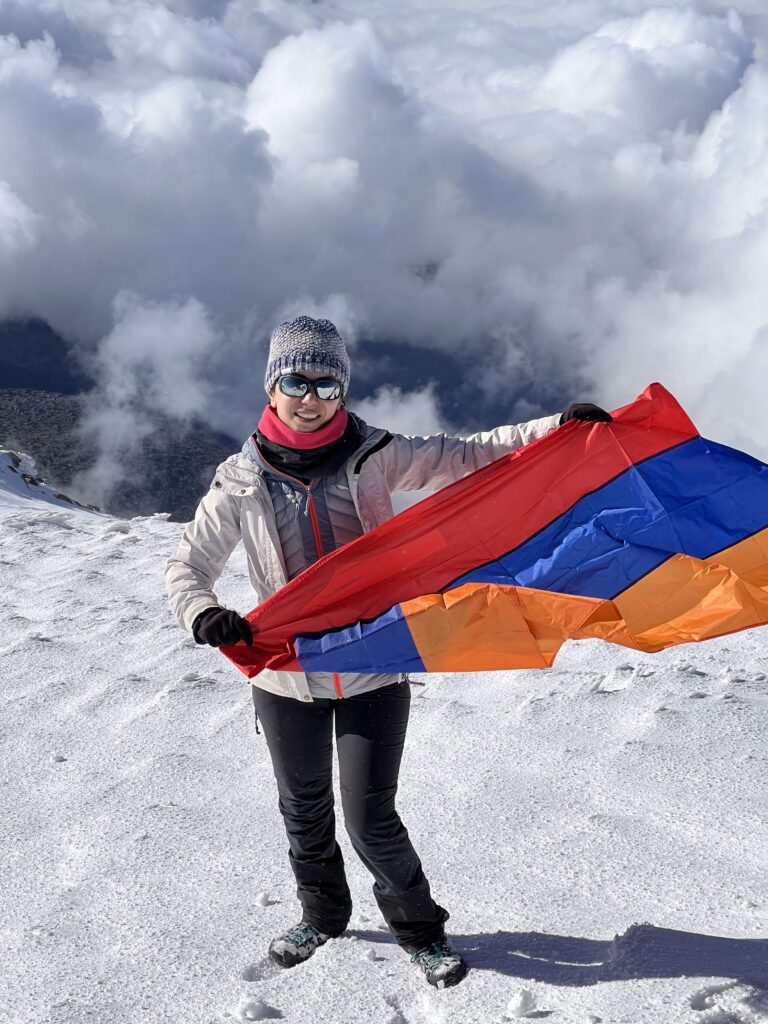
It was July 2024. The 26th. 5:40 in the morning.
Our group had gathered together. Some faces were familiar; others we were seeing for the first time. Without a doubt, each of us had our own heartbeat, our own expectations and our own hopes for one another and for Ararat.
We set off.
We crossed borders and mountains, making our way to stand on the other side of the Old Man (Ծերուկ).
“On the other side”…
The mountain we so often look at and imagine that, if we simply reached out our hand, we could touch it, stroke it.
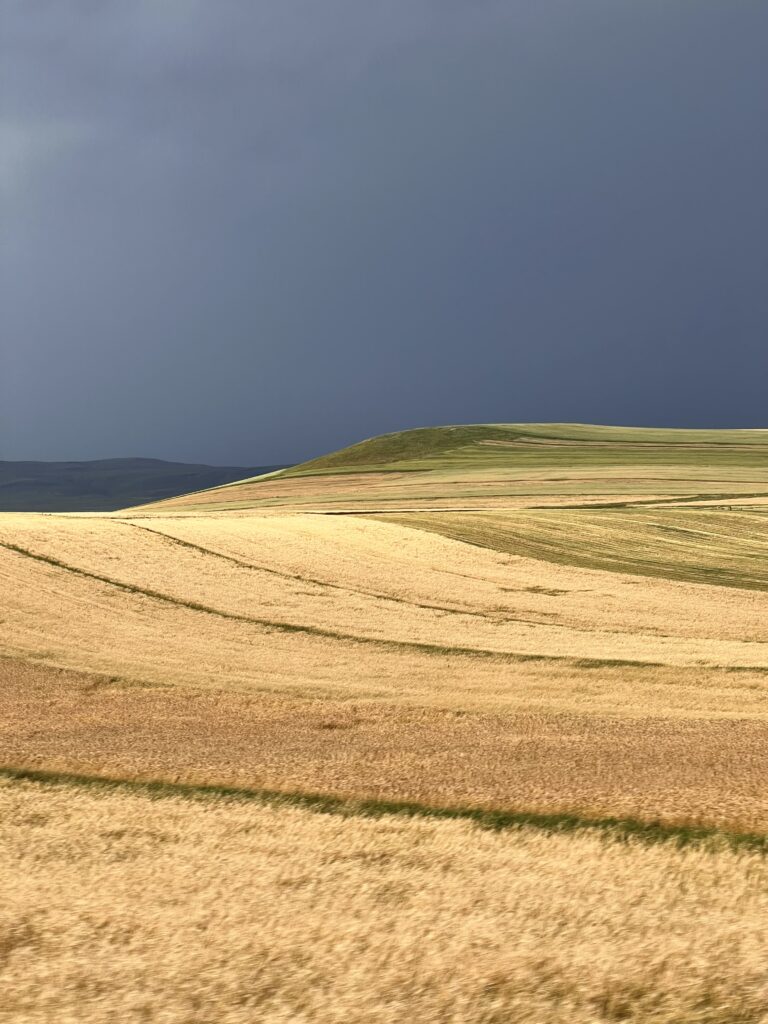
For me, the film began when we crossed into the historical Armenian lands on the other side. After passing Lake Çıldır (Ծովակն Հյուսիսո), a rainstorm suddenly began. Minutes later, it stopped and before us unfolded the Kars Plateau in an extraordinary palette of colours.
Dark clouds hung above us. Below, scorched grass, ploughed and painted fields and haystacks stood neatly arranged across the landscape. We drove for kilometres, and still it did not end neither the fields, nor the furrows, nor the colours painted by nature.
Then a rainbow appeared.
A good sign. A sign of promise.
Our first stop was supposed to be Ani, but we had spent too long at the border and could no longer make the visit. Gevorg decided that Khtzkonk Monastery was more important that day. Ani would have to wait until the final day.
We all disagreed silently in our minds.
But no one said a word.
We reached the place from which we had to walk another 800–900 metres to reach the monastery. In our tired state, we were all quietly complaining about having to walk even further just to see another monastery.
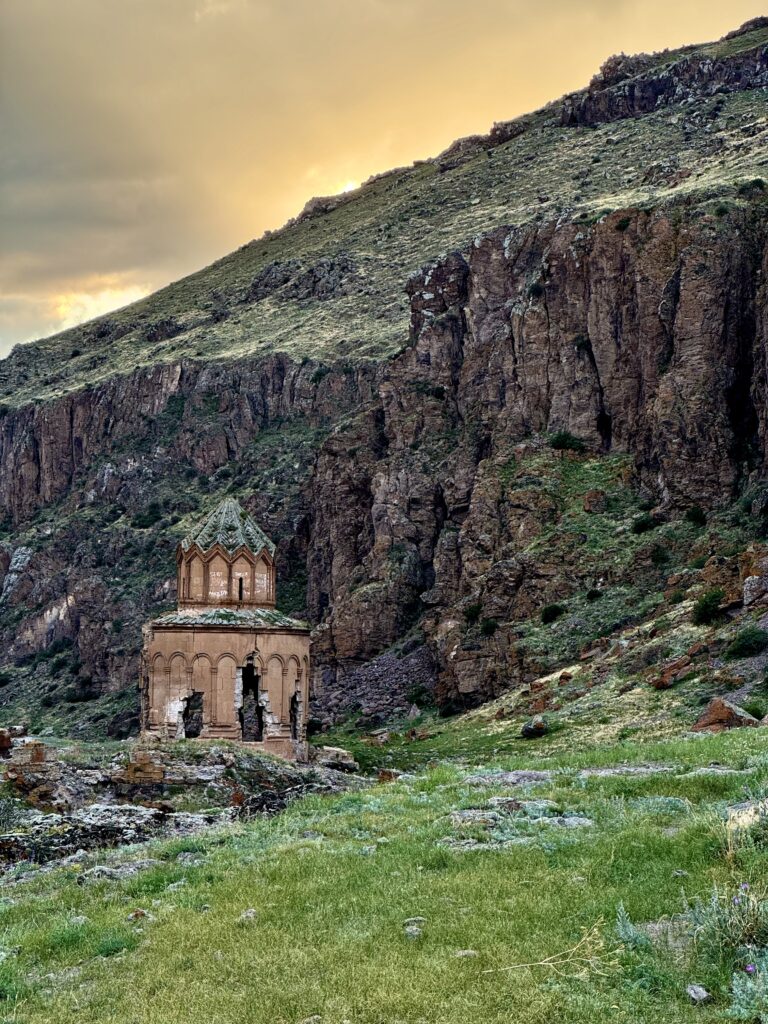
It was the golden hour. And thank God it was sunset.
The gold of the sun had spread everywhere, sliding across our faces and caressing every stone and bush. We descended into the gorge.
Yes, alright. This looks completely like Shirak. What are we even doing here? We could already have been on our way to the hotel, sleeping and resting. Tomorrow, the Old Man would be waiting for us.
We complained and walked.
And then, a second later, we stopped.
You don’t know whether you should approach or stay where you are.
What if you get closer and it collapses? What if you touch it and the whole thing falls apart?
You stare.
You cannot believe what you are seeing.
You look away, and somehow, it feels impossible not to look again.
Blended with the colours the sky had given to the golden evening, Khtzkonk was nestled into the crevice of the rock. A monastery that had endured the passage of time and the attacks of its enemies and had somehow survived.
Thank you, Gev, for deciding that we should visit Khtzkonk. As our first stop, it welcomed us with dignity and with love. We continued to Bayazet.
We needed sleep. We needed rest.
Morning would come and with it, one of the most important stages of our journey.
THE ROAD TO 3200 METERS
It was the 27th. Morning came. We had slept and rested.
We were ready to conquer the world. We went upstairs for breakfast and from the balcony of the dining room, we could see… Him.
The mountain to which so many pages of Armenian history have been devoted. The mountain spoken of by generations of Armenian greats, the mountain that has inspired countless travellers.
The Old Man was slightly hidden that morning. But it was alright.It certainly wasn’t our first time. After breakfast, we got into the cars and climbed to 2,200 metres, where we would begin our hike. The plan for the first day was to reach the first camp at 3,200 metres.
And you know us. There was always singing. So much singing that some people probably thought we were a choir. We sat down and immediately began singing about Ararat. We decided that at every altitude we reached, we would sing that song. Then “Bingol” came.
We walked slowly. It was hot. Although there had been so much rain that year that even the slopes of Ararat were green, it was still hot.
We sang. We talked“Khnjik-mnchik.”. Among us was “the youngest” member of the group, Artak — already climbing Ararat for the third time. Artak was smoking his patience pipe and climbing.
At one point, the man casually mentioned that when we reached 3,200 metres, there would be watermelon waiting for us. It sounded like a perfectly ordinary sentence. Nothing strange about it. And yet, that one word became the name of our team:
Ձմերուկ (Watermelon)!
So, if you ever come across that special name, know that it refers to “the Ararat 2024 Arevi group”. For three days, we told countless stories about watermelon. We dreamed about it. We ate it. And somehow, we never had enough.
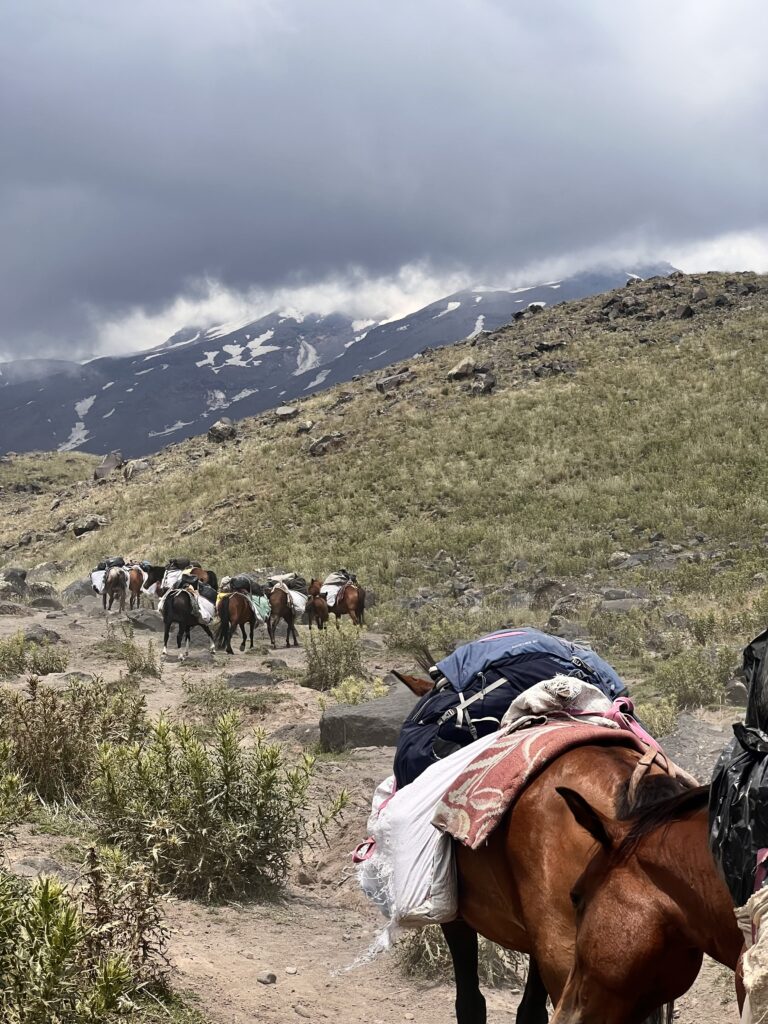
We walked and sweated, some in silence, others talking, stopping from time to time to let the exhausted horses carrying our belongings pass.
From the very first day, everyone found their place in the line and almost no one changed it for the entire journey. Not even the passing days could separate the person at the back from the person walking ahead. Everyone had found the person they naturally belonged beside. Every hour, we shouted:
“Sipan, give us the numbers!”
Sipan had become the group’s official source of reliable data.
“Give us the numbers” meant: altitude, distance, average speed, relative average…
Sipan had also brought friends, who provided a steady supply of sharp humour.
We had covered 60–70% of the route when the clouds over Bayazet suddenly rose, roared, grew angry and the sky exploded.
Rain. Cold. The only thing I wanted was to reach the camp as quickly as possible.
Hail mixed with rain struck our hands. None of us had brought gloves on the first day.
So, moving quickly and taking a beating from the hail, Watermelon reached the first camp.
And there, waiting for us on the tables, was the watermelon.
We ate. We rested. We divided up the tents and settled in.
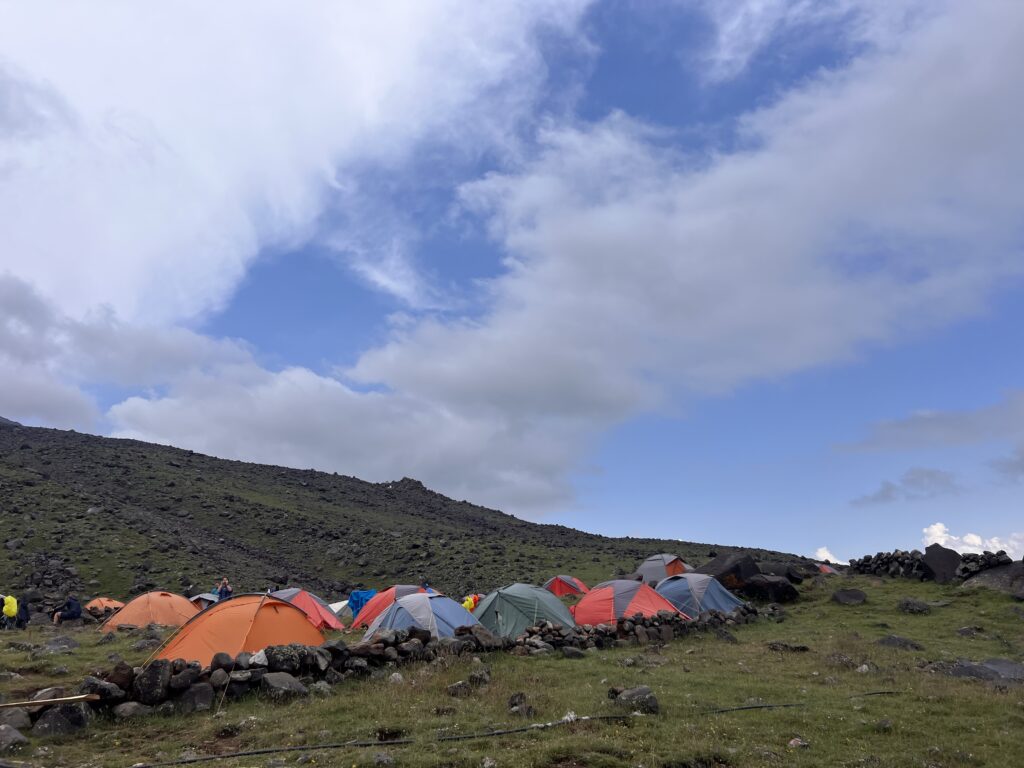
Then we waited for dinner. The Kurdish guides surprised us with an incredibly delicious soup. It was hot. It warmed us from within. The rain stopped. The clouds parted.And Ararat appeared. In the distance, Mount Tondrak revealed itself.
Our clothes were soaked. Gev told us:
“Do whatever you want, however you want , but don’t wear tomorrow’s climbing clothes. Keep them dry for the BIG DAY.”
And then he found a solution. He went and brought some gas and we lit the stove in the dining hall. Soon, our wet clothes and shoes were hanging everywhere, drying around us. In a matter of seconds, Watermelon had transformed the dining room into a laundry room.
The name was decided: Watermelon Laundry.
Those who understood physics told us we were wasting our time.
“Don’t hang them up. Whatever dries, dries. Whatever doesn’t, won’t.” But what does a humanities graduate’s stubborn brain understand about physics?
We did it anyway.
We were impatient. So we sang. Then we went to sleep. It was cold. Probably the coldest July of recent years. That same day, Yerevan had been hit by flooding. As usual, I could barely feel my feet. During the night, the Armenian mountain shepherd dogs, Gamprs, began howling. Perhaps they had noticed something. One of the children even needed to go outside to use the bathroom but decided not to. He thought the dog might follow him and then the person walking behind him would no longer recognize him from behind, the line would get mixed up and all for the sake of the line… He stayed.
The sunrise was waiting for us.
And perhaps, just perhaps, our dry clothes were too …
THE MOUNTAIN TESTS US
Morning came. Day 3. The 28th. Well…
The clothes had not dried. Neither had the shoes.
We woke at six in the morning to the sound of rain.
Cold.
And as if that weren’t enough, our tent was damaged and during the night the rain had poured straight onto Ani, who was sleeping beside me.
“Poured?” No, forgive me. A whole bucket of water had splashed onto Ani’s face.
We had been cold enough already.Now we were wet too. Tea was a blessing for our frozen hands and bodies.
One cup. Two. Three. The tea never seemed to end. Neither did the morning.
We were supposed to leave for the second camp at 3,200 metres. It was a flood. Only Noah’s Ark seemed to be missing. Even Mount Ararat was nowhere to be seen.
The other groups were talking among themselves. They were considering staying at the first camp because the weather was so bad that if they climbed higher, the horses might not be able to carry the equipment through the rain to 4,200 metres.
I don’t think I mentioned it: The plan for the day was to climb from 3,200 to 4,200 metres. The Armenian Highlands had turned against us. It had hidden itself beneath a thick mist. Ararat was testing us.
But, Old Man… You know us. We are stubborn.
Gevorg remained quiet and calm. There was chaos in the other groups. We kept coming and going, buzzing around him, trying to make him worry. But no. He remained completely calm.
Young man, perhaps you were sitting there eating sunflower seeds and taking life lightly? No. He simply knew what he was doing. He waited. The rain slowed. Then stopped. The mist disappeared. And Gev announced:
“Everyone get ready quickly. We’re going.”
The night before, Roza had announced:
“I have a feeling it won’t rain.”
The weather said otherwise. Everyone else said otherwise. But Rosa’s intuition is stronger than every forecast. Always. Believe me.
We started walking. And she was right. Not a single drop of rain fell for the entire journey.
We reached the second camp, and because we were the first group there, we claimed the best spots for our tents.
Then came the hot soup. Oh! Soup had never tasted so good. If my mother knew how delicious soup becomes at 4,200 metres, she would make us climb mountains every day just to eat it.
At 4,200 meters, Rosa and I sang.
There wasn’t much air left for singing. But Ararat gave us an endless supply of energy. So we sang “Գեղեցիկ, գեղեցիկ ես, դուն Արարատ հեյ ջան է” (Beautiful, beautiful you are, Ararat, my dear.)
After an early dinner, we hurried to lie down. We were supposed to wake at 1 am. and begin climbing at 2am.
We went to sleep. God knows how much we tossed and turned before we finally switched off. Some slept. Some didn’t. The adrenaline was high. Very high. But my heart wasn’t pounding because of the 4,200-metre altitude. It was pounding because we were waiting. Only a few hours remained until the great encounter.
Արարա՜տ, մեր հին, սիրուն Արարատ
Արարա՜տ, սիրտս քո անունով
Արարա՜տ, մեր հին, սիրուն Արարատ
Արարա՜տ, սիրտս քո անունով
Enjoy our song or perhaps enjoy !
THE SUMMIT
The night of the 28th into the 29th. Whether we slept or not, God knows. God also knew what Ararat meant to each of us. For one, it was sacred. For another, a sporting challenge. For someone else, simply the highest point of the Armenian Highlands.
For me, Ararat is not merely the silent witness to our history. It is the silent witness to each of our lives. I don’t know about you, but whenever I am tired or angry, Ararat is always there — a silent observer and listener. My personal psychologist. It is part of my daily routine to check whether it is visible. Almost like a member of the family. Perhaps because I can see it from my balcony. Perhaps because since childhood we have called it by a special name: “The Mountain”
At 1am, we woke up. It had rained around midnight, which meant there would probably be fresh snow at the summit. We had a light breakfast and set off at 2 a.m. Later, when you descend, you realize how fortunate you were to make the climb in darkness. Because when you descend in daylight, you can hardly believe that you climbed all that way. I lifted my head. All the other groups had started their ascent too. Lights stretched across the mountain, appearing and disappearing among the stars. I forgot to mention: the sky was full of stars. So clear that, if you wanted, you could almost reach up, pluck one from the sky and give it as a gift. We climbed. We reached the snow. Everyone became extremely careful with one another. Slowly, we continued upward. It was cold. Colder than it should have been. If someone had offered me even one more layer of clothing, I would have put it on. Even two layers of gloves and several pairs of socks weren’t enough.
I walked and dreamed about the sun.
Where are you? Come out. You’re the only one who can warm us now.
One step. Then another. The sky began turning deep blue. Another step. The blue became lighter. Slowly, we moved from dark to light.
Sis appeared. My incomparable Sis. Of all the mountains in this range, I love you the most.
We turned around. Far away, the horizon began to emerge. The stars gradually surrendered their places to the colours of the sky. A few more steps. And then… The sun rose. How much warmth can exist inside a single ray of light? The sun’s rays penetrated all the way into my soul. But my hands were still freezing. My fears kept visiting me, one after another. But every time, the same thought defeated them:
“No one has frozen to death in half an hour. Move your fingers,” Gev would have said.
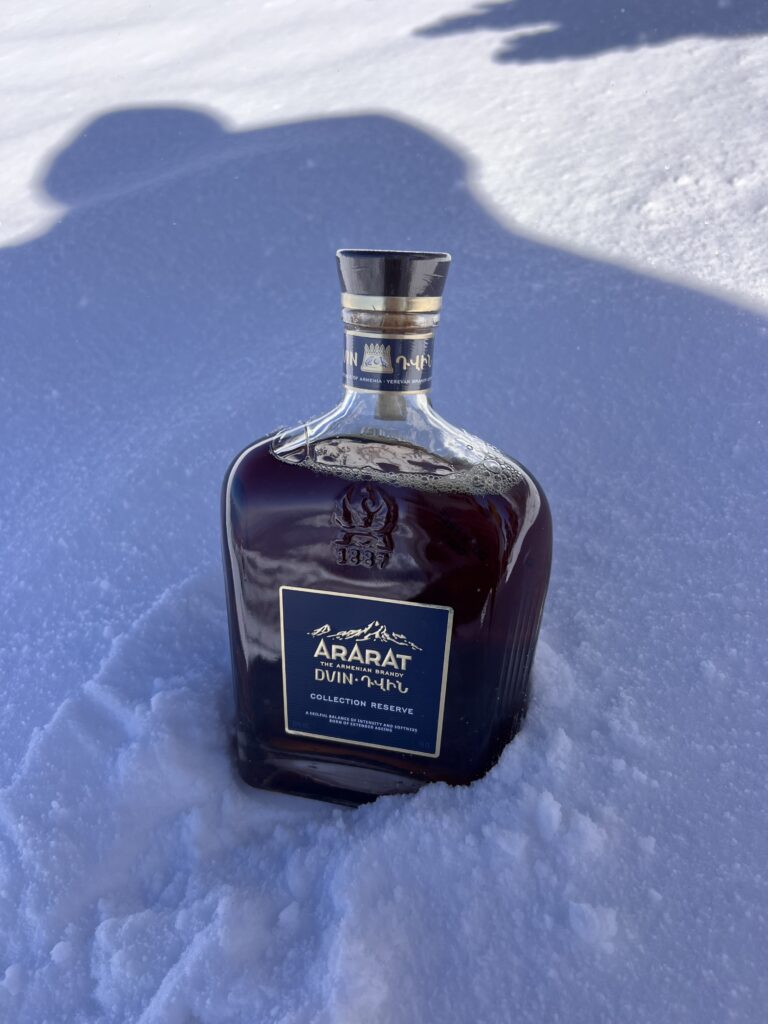
We reached 5,000 metres. Inside my backpack was a special gift:
Ararat brandy.
The higher we climbed, the more my shoulders felt its weight.
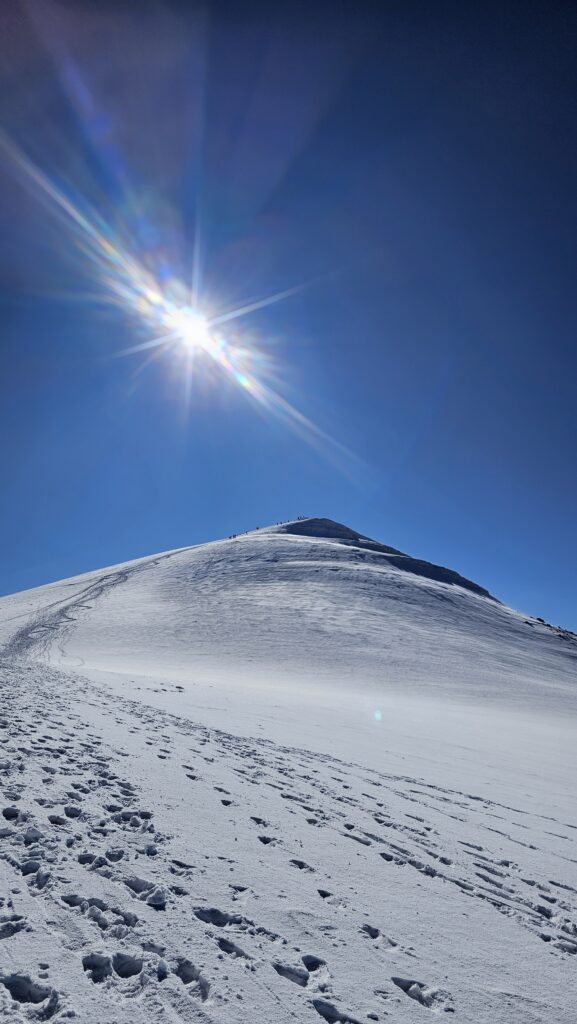
At the most hopeless moment — when the summit seemed to be seven mountains away — Gevorg said:
“Let’s get over this hill. We’ll be at the summit in half an hour.”
But that hill still seemed impossibly far away. We crossed it. And the summit finally came into view. People appeared. One group had reached it before us. We had overtaken another.
Old Man… You are extraordinary.
I curled and stretched my toes. Then my fingers. Again and again. Foot. Hand. Foot. Hand.
My breathing became difficult.
-Gev, can you give me some medicine?
-No. Keep walking. Everything is fine.
-But I can’t breathe properly.
-Walk.
So I walked. Another 50 metres or so, and my body adapted surprisingly quickly. Only the final stretch remained.
“Rosa, how are you? Are your hands warm? You can do it. Keep walking. There’s almost nothing left.”
And then, a few minutes later…
Ինչպես անհաս փառքի ճամփա,
Ես իմ Մասիս սարն եմ սիրում
(Like the road toward unattainable glory,
I love my Mount Masis.)
Love? No. Believe me, there is no verb capable of describing what I feel toward this mountain. And this isn’t empty pathos. It isn’t simply because it is the Biblical mountain. It isn’t only because it is the silent witness to history.
It is simply Ararat.
And even if it were none of those things, nothing could ever diminish what it is.
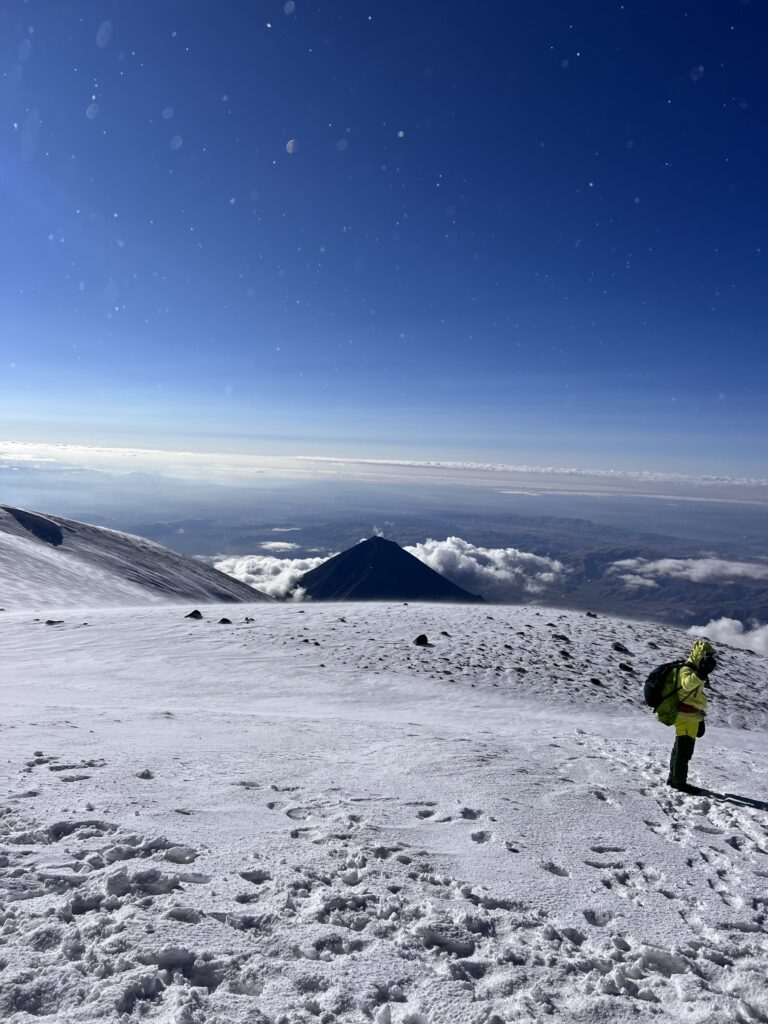
At 7:02 a.m., we reached the summit. I stood there and looked out over the Armenian world. The entire Ararat valley and Bayazet valley seemed to fit inside the palm of my hand. The cold of the previous days had given us something in return: an extraordinary view. Even the fiercest wind could not pull us out of our state of awe.
Look to the right: Nakhichevan, Iran. Look to the left: Armenia, Yerevan was there
Turn around: Lake Van and Tondrak, Sinak, Lake Gaylalich. Even Armavir and Yervandashat could be seen.
We stayed at the summit for fifteen minutes. The fresh layer of snow had turned into tiny hailstones and the wind whipped them against us. Especially our faces, especially our hands.
Did we believe that we had really climbed it? No!
Not until you descend, return, rest and finally allow yourself to understand what happened can you truly comprehend that you climbed the mountain. Even more so when you look at Ararat from Bayazet. You simply cannot believe that only hours earlier, at dawn, you were standing up there.
But what happened, happened. We climbed. It’s time to descend.
We were hungry. The adrenaline was fading and hunger was taking its place. We would reach Bayazet. Adana kebab was waiting for us.
The team was powerful
INDIVIDUALLY AND TOGETHER!